HomeService / Lithium Battery Export Compliance Logistics
Core services

Lithium Battery Export Compliance

Assess lithium battery export options by UN number, battery configuration, quantity, applicable test documentation, packaging and destination. Carrier acceptance, required documents and the shipment schedule must be confirmed before booking.

Export services for companies in China

GENORDA provides chemical and dangerous goods export services for companies in China, with Hong Kong as its core operating hub. Customers can request an assessment without choosing a departure gateway in advance.

Who can enquire?

Chemical businesses, research companies, traders and laboratories in mainland China can submit cargo information for assessment.

Where is the work performed?

Mainland coordination is arranged per project through Shenzhen Kangjienuoda International Logistics Co., Ltd. or the actual executing party. GENORDA handles Hong Kong operations within its actual service and permission scope.

How is the destination assessed?

Each shipment is reviewed for classification, quantity, packaging, recipient import readiness and carrier requirements. Mainland pickup area, vehicle qualifications, handover point and fees require separate confirmation.

Submit cargo information →

BEFORE YOU ENQUIRE

Service suitability and enquiry checklist

Review these conditions before preparing an enquiry. Preliminary review, carrier acceptance and a final quotation are separate steps. Transport acceptance and product market access are separate reviews; no single certificate replaces testing, packaging and carrier acceptance checks.

Suitable clients

  • Manufacturers, traders and equipment businesses assessing exports of lithium ion or lithium metal cells/batteries.
  • Customers shipping batteries on their own, packed with equipment or contained in equipment, assessed against UN3480/3481/3090/3091 as applicable.
  • Larger energy-storage/power batteries require a separate review of specifications, dimensions, testing and carrier resources; prototype/low-production goods are not automatically covered by standard arrangements.

Documents and cargo details

  • Provide cell/battery model, manufacturer, chemistry, cell and battery counts, and whether shipped alone, packed with equipment or contained in equipment.
  • Provide watt-hour ratings and applicable state of charge for lithium ion batteries, or lithium content for lithium metal batteries, plus quantity and net weight per package.
  • Provide a matching UN38.3 test summary and available test records; supply an MSDS or product technical data as required for review and carrier acceptance.
  • Provide photos showing packaging, short-circuit protection and restraint, package count/dimensions/gross weight, invoice/packing list and origin/destination details.

Review steps

  1. Confirm battery type, UN entry and configuration; check that test records match the actual model.
  2. Check watt-hour rating/lithium content, state of charge, quantities/net weight and packaging against the mode and packing instruction.
  3. Check short-circuit protection, prevention of accidental activation and restraint, plus required marks, labels, documents and personnel duties.
  4. Confirm acceptance with the selected express, air or sea resources, then agree costs and milestones before booking and handover.

Possible reasons for refusal

  • Damaged, swollen, recalled or potentially defective batteries are not accepted through the standard service described here.
  • Missing applicable test records, a model mismatch or unclear classification requires further evidence; special approval cannot be assumed.
  • Noncompliant state of charge, quantities, net weight or packaging, or inadequate short-circuit protection/restraint, may cause rejection.
  • Flight, shipping line, destination or account restrictions may leave no available option; sample status or small quantities do not automatically create an exemption.

Cost components

  • Check main freight by the actual express/air/sea service, chargeable weight or container type, and route.
  • Itemise applicable dangerous goods surcharges, handling/declaration, packaging and short-circuit protection materials.
  • Agree the scope, lead time, cost and responsible party for additional testing, records or special review; these are not automatically included.
  • State the scope and payer for collection/cross-border road transport, destination clearance/delivery, duties/taxes, storage and returns.

Rule sources

Checked on

· This date records the check of public rule sources and the service conditions described on this page. The rules in force and carrier confirmation apply to each shipment.

After preparing your cargo details, share them by WeCom or email. Acceptance and the final quotation require confirmation for the shipment.

Prepare cargo details for assessment
Export of lithium batteries for compliance transport
UN Number

Four lithium battery UN entries

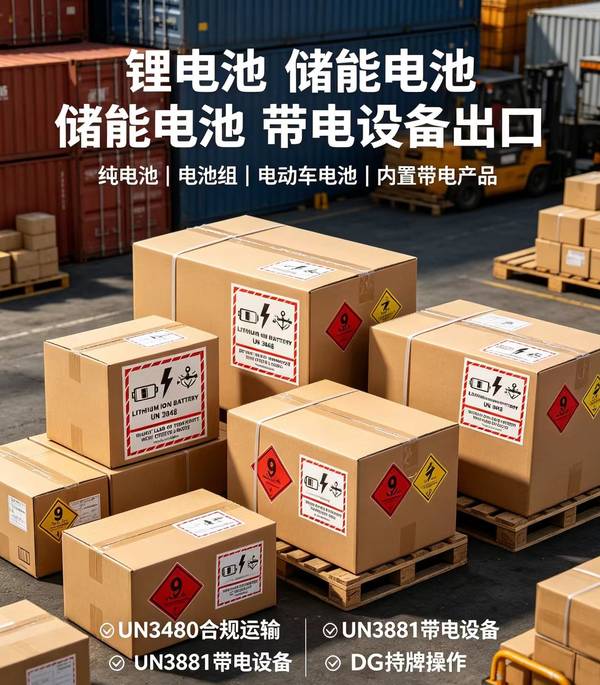
Lithium batteries are classified as miscellaneous dangerous goods of Class 9, with different UN numbers for different types and modes of transport, and different packing requirements and transport restrictions.

UN3480

Lithium ion batteries

Lithium ion cells and batteries shipped on their own

UN3481

Lithium ion batteries with equipment

Lithium ion batteries packaged or installed with equipment

UN3090

Lithium metal batteries

Lithium metal cells and batteries shipped on their own

UN3091

Lithium metal batteries with equipment

Lithium metal batteries packaged or installed with equipment

Compliance requirements

Four compliance requirements for the export of lithium batteries

1

UN38.3 Test report

Check applicable UN38.3 testing, the test summary and available records for the actual cell/battery model. Prototype, low-production or other special arrangements require separate rule and approval checks.

2

MSDS or Product Technical Data

Provide an MSDS or product technical data describing the actual battery chemistry, specifications, hazards and response measures; required information depends on the review and carrier conditions.

3

UN Compliance Packaging

Protect batteries against short circuits and movement. Confirm the required outer packaging, quantity limits, marks and labels against the applicable packing instruction and carrier conditions.

4

Dangerous goods handling coordination

Confirm personnel training and authorization for their duties. Review classification, packaging, marks, labels and declarations against the applicable rules and carrier conditions.

Packaging Elements

Key elements of lithium battery packaging

  • Confirm inner packaging, short-circuit protection and other protection against the applicable packing instruction and battery configuration
  • Protect battery terminals against short circuits with suitable insulation or covers.
  • Confirm whether UN performance-tested outer packaging is required by the applicable UN entry, packing instruction and carrier.
  • Confirm required battery marks, dangerous goods labels and UN numbers under the applicable entry and packing instruction
  • Check the watt-hour rating and applicable quantity or weight limits for the battery and packing instruction.
  • Use of buffer material in packaging to prevent cell movements and collisions
  • Provide applicable test summaries or accessible test records, commercial documents, and an MSDS or product technical data as required for the shipment

Common violation risk

  • ⚠Impression of lithium batteries as common and fined for seizure at the airport
  • ⚠Failure to meet applicable packaging and short-circuit protection requirements can create a risk of short circuit or fire
  • ⚠Batteries are not short-circuited and electrodes are in danger.
  • ⚠Exceeding the applicable watt-hour, quantity or weight limits
  • ⚠Lack of UN38.3 test reports, detained by the Customs of destination
  • ⚠Not labelled as dangerous, rejected by airlines

GENORDA coordinates a further packaging check before handover against the confirmed shipment requirements.

Service details

Complete information on export compliance logistics for lithium batteries

What can you transport?

  • • UN3480 Lithium ion batteries (separated)
  • • UN3481 Lithium ion batteries (incorporated/accompanied with equipment)
  • • UN3090 Lithium metal batteries (separated)
  • • UN3091 Lithium metal batteries (incorporated/accompanied with equipment)
  • • Consumer-type electronic products (lithium-containing batteries)
  • • Energy and power batteries (separately examined)

Can't transport what?

  • • Damaged or swollen lithium batteries
  • • Batteries not tested at UN38.3
  • • Goods with missing or unverifiable battery technical information required for review
  • • Large batteries in excess of carrier capacity limits
  • • Counterfeiting of branded lithium batteries (tort risk)

Information required

  • • Matching UN38.3 test summary and applicable test records
  • • MSDS or product technical data, as required for review and carrier acceptance
  • • Information on goods (model, capacity, weight)
  • • Commercial invoices and packing lists

Packaging requirements

  • • Check packaging and performance requirements under the applicable entry and packing instruction
  • • Insulation packaging to prevent short circuits
  • • Confirm inner packaging and protection for the actual battery configuration and applicable packing instruction
  • • Check the required marks and labels under the applicable entry and packing instruction

Channels considered for assessment

  • • FedEx/DHL/UPS Express, Hong Kong
  • • Hong Kong airport cargo flights
  • • Maritime transport (IMDG Code standard)
  • • Major global countries and territories

Timing and service scope

  • • Confirm available express services and expected milestones against actual acceptance
  • • Confirm flights, capacity and timing scope separately
  • • Confirm the sailing schedule and destination port delivery scope separately
  • • Missing documents, review, security screening, capacity and clearance may affect arrangements

Quotation factors

  • • Battery type (lithium ion/ lithium metal)
  • • Mode of transport (fast delivery/air/sea transport)
  • • Battery capacity and weight
  • • Destination countries and channels

Conditions and limitations

Information date: 15 September 2026

Conditions of application:The above-mentioned prescription and channel information is based on current operational experience, and the actual timeliness and available channels may vary depending on the carrier policy, flight adjustments and changes in destination regulations.

Statement of quotation:Any displayed amounts are indicative. The actual quotation, included services, exclusions and validity are confirmed in writing after the cargo has been reviewed.

Compliance responsibilities:The shipper must provide accurate, applicable test records and an MSDS or product technical data matching the actual battery model. Classification, document and handling responsibilities are confirmed for each shipment.
FAQ

Lithium Battery Export FAQ

1.What certification and documentation are required for the export of lithium batteries?

Start with a matching UN38.3 test summary and available test records, battery specifications, configuration, packaging photos, invoice and packing list. Confirm an MSDS or technical data and any mainland gateway documents against review and carrier requirements. UN performance-tested packaging depends on the applicable packing instruction; document and packaging requirements are not identical for all batteries.

2.What Is the Difference Between UN3480, UN3481, UN3090 and UN3091?

UN3480 identifies lithium ion batteries shipped on their own; UN3481 identifies lithium ion batteries packed with or contained in equipment. UN3090 identifies lithium metal batteries shipped on their own; UN3091 identifies lithium metal batteries packed with or contained in equipment. The configuration, battery specifications, packing instruction and carrier conditions determine the applicable requirements.

3.What are the modes of transport for lithium batteries?

Assess express, air or sea options by battery type, configuration, quantities, packaging and destination; shipment size alone does not determine availability. The selected carrier must accept the specific UN entry and conditions. Air requirements differ for standalone, packed-with-equipment and contained-in-equipment batteries, and shipping line acceptance requires a separate check. Confirm expected milestones and delivery scope for each shipment.

4.Do lithium batteries need CE certification for export to Europe?

Product market access and transport acceptance require separate checks. Review applicable EU battery requirements, product rules and transition dates for the actual product with the responsible importer or compliance specialist. Transport review covers the applicable battery test documentation, classification, packaging, marks, labels and carrier conditions; do not assume a single certificate satisfies all requirements.

5.Can lithium batteries exit without UN38.3 test reports?

If applicable UN38.3 documentation is missing, first review the battery type, test status, test summary and carrier requirements before deciding whether shipment can proceed. Small quantities or sample status do not justify assuming that EQ or LQ removes lithium battery testing and transport requirements. Prototype, low-production or other exceptional arrangements require a separate check against the applicable rules and carrier conditions. Testing time, fees and acceptance must be confirmed for the actual project.

Reviewed · Reviewer: Company Team Members · 2026-10-08